
Exceptions
Exceptions in java are any abnormal, unexpected events or extraordinary conditions that may occur at compile or at runtime. They could be file not found exception, unable to get connection exception and so on. On such conditions java throws an exception object. Java Exceptions are basically Java objects. No Project can never escape a java error exception.
Java exception handling is used to handle error conditions in a program systematically by taking the necessary action. Exception handlers can be written to catch a specific exception such as Number Format exception, or an entire group of exceptions by using a generic exception handlers. Any exceptions not specifically handled within a Java program are caught by the Java run time environment.
An exception is a subclass of the Exception class. Exception and Error classes, are subclasses of the Throwable class.
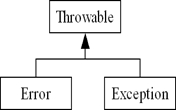
Java exceptions are raised with the throw keyword and handled within a catch block
Throwable Class
The Throwable class provides a String variable that can be set by the subclasses to provide a detail message that provides more information of the exception occurred. All classes of throwables define a one-parameter constructor that takes a string as the detail message.
The class Throwable provides getMessage() function to retrieve an exception. It has a printStackTrace() method to print the stack trace to the standard error stream. Lastly it also has a toString() method to print a short description of the exception. For more information on what is printed when the following messages are invoked, please refer the java docs.
Syntax
String getMessage() Returns the detail message string of this throwable (which may be null).
void printStackTrace() Prints this throwable and its backtrace to the standard error stream
A typical example:
| 1 | class MyClass { |
| 2 |
public static void main(String[] args) { |
| 3 |
crunch(null); |
| 4 |
} |
| 5 |
static void crunch(int[] a) { |
| 6 |
mash(a); |
| 7 |
} |
| 8 |
static void mash(int[] b) { |
| 9 |
System.out.println(b[0]); |
| 10 |
} |
| 11 | } |
produces
Exception in thread "main" java.lang.NullPointerException
	at MyClass.mash(MyClass.java:9)
	at MyClass.crunch(MyClass.java:6)
	at MyClass.main(MyClass.java:3)
Class Error
Errors are irrecoverable condtions that can never be caught. Example: Memory leak, LinkageError etc. Errors are direct subclass of Throwable class.
Class Exception
The class Exception represents exceptions that a program faces due to abnormal or special conditions during execution. Exceptions can be of 2 types: Checked (Compile time Exceptions)/ Unchecked (Run time Exceptions).
Class RuntimeException
java.lang.Object
java.lang.Throwable
java.lang.Exception
java.lang.RuntimeException
Runtime exceptions represent programming errors that manifest at runtime. For example ArrayIndexOutOfBounds, NullPointerException and so on are all subclasses of the java.lang.RuntimeException class, which is a subclass of the Exception class. They implement the interface Serializabe.
Checked and Unchecked Exceptions
Checked exceptions are subclass’s of Exception excluding class RuntimeException and its subclasses. Checked Exceptions forces programmers to deal with the exception that may be thrown. When a checked exception occurs in a method, the method must either catch the exception and take the appropriate action (using try-catch clause), or pass the exception on to its caller method via throws clause (declared in the ptototype of the method).
Method() throws
<ExceptionType1>,…, <ExceptionTypen> { // exception
declared in the prototype of the method
<code>
}
Exception Statement Syntax
Exceptions are handled using a try-catch-finally construct, which has the Syntax
try
{
<code>
} catch (<exception type1> <parameter1>) { // 0 or
more catch bloks
// 0 or more <statements>
}
} finally { // 1 or 0 finally block
<statements>
}
try Block
The java code that you think may produce an exception is placed within
a try block for a suitable catch block to handle the error.
If no exception occurs the execution proceeds with the finally block else it will look for the matching catch block to handle the error. Again if the matching catch handler is not found execution proceeds with the finally block and the default exception handler throws an exception.. If an exception is generated within the try block, the remaining statements in the try block are not executed.
catch
Block
Exceptions thrown during execution of the try block can be caught and
handled in a catch block. On exit from a catch block, normal execution continues
and the finally block is
executed (Though the catch block throws an exception).
finally
Block
A finally block is always executed, regardless of the cause of exit
from the try block, or whether any catch block was
executed. Generally
finally block is used for freeing resources, cleaning up,
closing connections etc. If the
finally clock executes a control transfer statement such as a
return or
a break statement, then this control statement determines how the
execution will proceed regardless of any
return or control statement present in the try or catch.
Some predefined Exceptions:
Exception
ClassNotFoundException
IllegalAccessException
InterrupredException
NoSuchMethodException
RuntimeException
ArithmeticException
ArrayStoreException
ClassCastException
NegativeArraysizeException
NullPointerException
SecurityException
IndexOutOfBoundsException
String IndexOutOfBoundsException
Array IndexOutOfBoundsException
IllegalArgumentException
NumberFormatException
IllegalThreadStateException
1. For each try block there can be zero or more catch blocks, but only one finally block.
|
Example 1: Addition of 2 int numbers - without exception catch
Example 2: Addition of 2 int numbers - with unchecked exception catch
import java.util.Scanner;A program can also explicitly throw an exception using the throw statement.
The general format of the throw statement is as follows:
throw <exception reference>;
The Exception reference must be of type Throwable class or one of its subclasses. A detail message can be passed to the constructor when the exception object is created.
throw new TemperatureException(”Too hot”);
A throws clause can be used in the method prototype.
Method() throws <ExceptionType1>,…, <ExceptionTypen> {
}
Each <ExceptionTypei> can be a checked or unchecked or sometimes even a custom Exception. The exception type specified in the throws clause in the method prototype can be a super class type of the actual exceptions thrown. Also an overriding method cannot allow more checked exceptions in its throws clause than the inherited method does.
When an exception is thrown, normal execution is suspended. The runtime system proceeds to find a matching catch block that can handle the exception. Any associated finally block of a try block encountered along the search path is executed. If no handler is found, then the exception is dealt with by the default exception handler at the top level. If a handler is found, execution resumes with the code in its catch block. Below is two examples to show the use of a throws and a throw statement.
Example (catch in the function):
| package
p3; import java.util.*; class NoAssessment extends Exception{ private static final long serialVersionUID = 1L; String message; NoAssessment(String message){ this.message = message; System.out.println(message); } } public class Exc4 { public static void main(String arg[]){ System.out.println("Note: "+Note()); } static int Note(){ Scanner sc = new Scanner(System.in); boolean ok; int note=-1; do{ ok = true; System.out.print("next note:"); try { note = Integer.parseInt(sc.nextLine()); } catch(NumberFormatException ex) { ok=false; System.out.println("Integer please!"); continue; } try{ if((note>6)||(note <2)){ throw new NoAssessment("outside [2,6]"); } } catch(NoAssessment ex){ ok = false; System.out.println("Integer is not between 2 and 6!"); } }while(!ok); sc.close(); return note; } } |
Example (catch outside the function ):
| package
p4; import java.util.Scanner; class NoAssessment extends Exception{ private static final long serialVersionUID = 1L; String message; NoAssessment(String message){ this.message = message; System.out.println(message); } } public class Exc5 { static Scanner sc=new Scanner(System.in); public static void main(String arg[]){ int note=0; //initialization boolean ok; do{ ok=true; try{ note = Note(); } catch(NoAssessment ex){ ok = false; } catch(NumberFormatException im){ ok=false; System.out.println ("Integer please"); } }while(!ok); System.out.println("Note: "+note); } static int Note() throws NoAssessment{ int note; System.out.print("next note:"); note = Integer.parseInt(sc.nextLine()); if((note>6)||(note <2)){ throw new NoAssessment("outside [2,6]"); } return note; } } |
Example
class Bull extends Exception{
|
animals: animal: ADULT, FEMALE,herbivore:FAST animal: YOUNG, FEMALE,herbivore:FAST animal: ADULT, MALE,herbivore:SLOW animal: ADULT, MALE,herbivore:FAST animal: ADULT, FEMALE,herbivore:FAST animal: ADULT, FEMALE,herbivore:SLOW animal: ADULT, MALE wolf , starving:true animals: animal: ADULT, FEMALE,herbivore:FAST animal: YOUNG, FEMALE,herbivore:FAST animal: ADULT, MALE,herbivore:SLOW animal: ADULT, MALE,herbivore:FAST animal: ADULT, FEMALE,herbivore:FAST animal: ADULT, MALE wolf , starving:true animals: animal: ADULT, FEMALE,herbivore:FAST animal: YOUNG, FEMALE,herbivore:FAST animal: ADULT, MALE,herbivore:SLOW animal: ADULT, MALE,herbivore:FAST animal: ADULT, MALE wolf , starving:true BULL FOUND!! _____________________________ animals: animal: YOUNG,
MALE,herbivore:SLOW |