
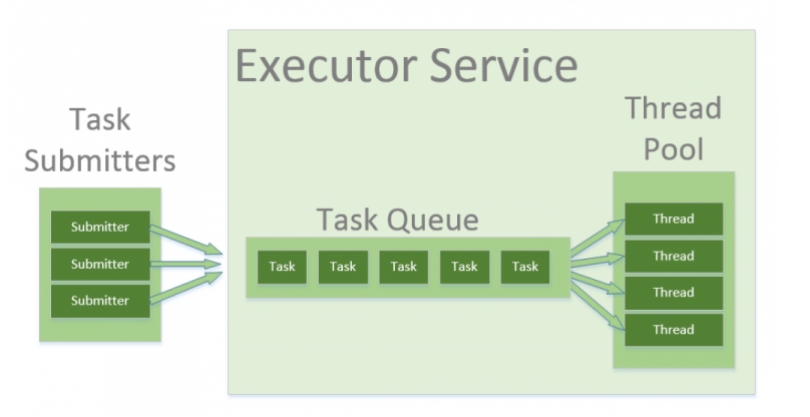
 |
Java 1.5 . |
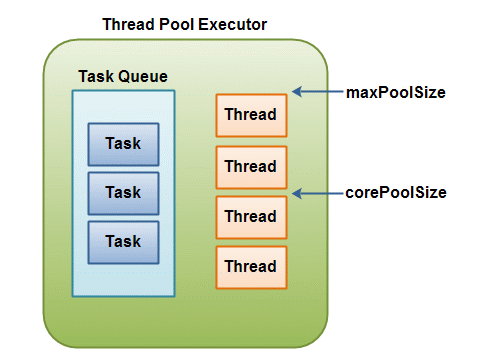 |
public ThreadPoolExecutor(int corePoolSize, |
getPoolSize())
based on the limits set by corePoolSize (see getCorePoolSize())
and maximumPoolSize (see getMaximumPoolSize()).
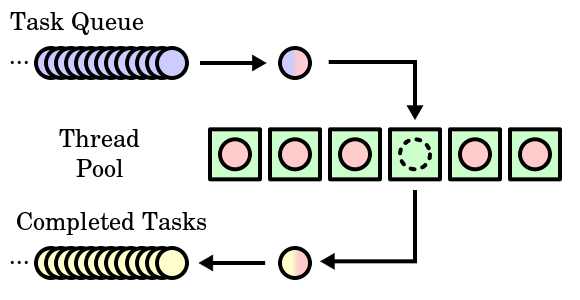 |
The choice of number of threads is very
important! Too many threads - waste of time creating unused resources. Few threads - tasks are waiting. For more information on number of threads: ideal thread pool size |
| F0 | F1 | F2 | F3 | F4 | F5 | F6 | F7 | F8 | F9 | F10 | F11 | F12 | F13 | F14 | F15 | F16 | F17 | F18 | F19 | F20 |
| 0 | 1 | 1 | 2 | 3 | 5 | 8 | 13 | 21 | 34 | 55 | 89 | 144 | 233 | 377 | 610 | 987 | 1597 | 2584 | 4181 | 6765 |
| import
java.util.concurrent.*; public class ThreadPoolTest { public static void main(String[] args) { int nTasks = 20; // number of tasks to be submitted to pool long n = 40; //Fibonacci number int tpSize = 5; // corePoolSize LinkedBlockingQueue<Runnable> q; ThreadPoolExecutor tpe = new ThreadPoolExecutor( tpSize, tpSize+3, 50000L, TimeUnit.MILLISECONDS, ( q=new LinkedBlockingQueue<Runnable>())); /* public ThreadPoolExecutor(int corePoolSize, int maximumPoolSize, long keepAliveTime, TimeUnit unit, BlockingQueue<Runnable> workQueue) */ System.out.println("Initial number of threads:"+tpe.getActiveCount()); Task[] tasks = new Task[nTasks]; for (int i = 0; i < nTasks; i++) { tasks[i] = new Task(n, "Task " + i,tpe); tpe.execute(tasks[i]); System.out.println("submittint task "+i+ " number of active threads "+tpe.getActiveCount()+ " number of task in the queue "+q.size()); } tpe.shutdown( ); } } --------------------------------------------------------------------------- import java.util.Date; import java.util.concurrent.ThreadPoolExecutor; import java.text.DateFormat; import java.text.SimpleDateFormat; public class Task implements Runnable { long n; String id; ThreadPoolExecutor tpe; private long fib(long n) { if (n == 0) return 0L; if (n == 1) return 1L; return fib(n - 1) + fib(n - 2); } public Task(long n, String id, ThreadPoolExecutor tpe) { this.n = n; this.id = id; this.tpe=tpe; } public void run( ) { Date d = new Date( ); DateFormat df = new SimpleDateFormat("HH:mm:ss:SSS"); long startTime = System.currentTimeMillis( ); d.setTime(startTime); System.out.println("Starting task " + id + " at " + df.format(d)+ "; active threads:" +tpe.getActiveCount()+" queue size "+tpe.getQueue().size()); System.out.println("\tfibonatchi "+ n+":"+ fib(n)); long endTime = System.currentTimeMillis( ); d.setTime(endTime); System.out.print("\tEnding task " + id + " at " + df.format(d) +" after " + (endTime - startTime) + " milliseconds"); System.out.println( " active threads: "+tpe.getActiveCount()+ " queue size "+tpe.getQueue().size()); } } |
| package
pool; import java.util.Date; import java.util.concurrent.ThreadPoolExecutor; import java.text.DateFormat; import java.text.SimpleDateFormat; public class Task1 implements Runnable { long n; String id; ThreadPoolExecutor tpe; Date dt; long crTime; private long fib(long n) { if (n == 0) return 0L; if (n == 1) return 1L; return fib(n - 1) + fib(n - 2); } public Task1(long n, String id, ThreadPoolExecutor tpe) { this.n = n; this.id = id; this.tpe=tpe; dt = new Date( ); DateFormat df = new SimpleDateFormat("HH:mm:ss:SSS"); crTime = System.currentTimeMillis( ); dt.setTime(crTime); System.out.println("Creating task " + id + " at " + df.format(dt)+ "; active threads:" +tpe.getActiveCount()); } public void run( ) { Date d = new Date( ); DateFormat df = new SimpleDateFormat("HH:mm:ss:SSS"); long startTime = System.currentTimeMillis( ); d.setTime(startTime); System.out.println("Starting task " + id + " at " + df.format(d)+ "; active threads:" +tpe.getActiveCount()); System.out.println("\tfibonatchi "+ n+":"+ fib(n)); long endTime = System.currentTimeMillis( ); d.setTime(endTime); System.out.println("\tEnding task " + id + " at " + df.format(d) +" after " + (endTime - startTime) + " milliseconds"); System.out.println("\tafter creating " + id + " at " + df.format(d) +" after " + (endTime - crTime) + " milliseconds"); } } |
| public
class Bridge { private int nVh; private boolean open; // for the bridge private int consVehicle; //consecutive cars in one direction private int limit; // max consecutive cars Bridge(int limit){ nVh = consVehicle =0; //nVh>0 - vehicles crossing from right to left are on the bridge //nVh<0 - vehicles crossing from left to right are on the bridge open = true; this.limit = limit; } synchronized public int brN(){ return nVh; } synchronized public void takeB(boolean lr ){ while((nVh>0)&& (lr==true)|| (nVh<0) && (lr==false) || !open){ System.out.println("\t"+Thread.currentThread().getName()+" waiting"); try{ wait(); } catch(InterruptedException e){ System.err.println(e); } } System.out.println(Thread.currentThread().getName()+" on the bridge"); if (lr) nVh--; else nVh++; if( ++ consVehicle >= limit){ open = false; System.out.println ("The bridge is closed"); } } synchronized public void leaveB(boolean lr ){ if (nVh>0) nVh--; else nVh++; System.out.println("\t\t"+Thread.currentThread().getName()+" leave the bridge"); if (nVh == 0){ open = true; consVehicle =0; System.out.println ("The bridge is open"); } notifyAll(); } } |
| public class Vehicle
implements Runnable{ boolean lr; Bridge b; String name; static int num; Vehicle(boolean lr, Bridge b){ this.lr=lr; this.b = b; name = "V "+ ++num + (lr?" left->":" <-right"); } public void run(){ Thread.currentThread().setName(name); try { //arriving to bridge Thread.sleep(20); } catch (InterruptedException e){} b.takeB(lr); try { // crossing the bridge Thread.sleep(300); } catch (InterruptedException e){} b.leaveB(lr); } } |
| import
java.util.concurrent.*; public class Circ { public static void main(String arg[]){ int tpSize = 5; // corePoolSize ThreadPoolExecutor tpe = new ThreadPoolExecutor( tpSize, tpSize, 50000L, TimeUnit.MILLISECONDS, ( new LinkedBlockingQueue<Runnable>( ))); Bridge b = new Bridge(5); for(int i = 0; i < 20; i++){ try { Thread.sleep(20); } catch (InterruptedException e){} tpe.execute(new Vehicle(Math.random()>0.5?true:false, b)); } tpe.shutdown(); } } |
| import
java.util.concurrent.*; public class Circ { public static void main(String arg[]){ int tpSize = 5; // corePoolSize ThreadPoolExecutor tpe = new ThreadPoolExecutor( tpSize, tpSize+2, 50000L, TimeUnit.MILLISECONDS, ( new LinkedBlockingQueue<Runnable>( 13))); Bridge b = new Bridge(5); for(int i = 0; i < 20; i++){ try { Thread.sleep(20); } catch (InterruptedException e){} tpe.execute(new Vehicle(Math.random()>0.5?true:false, b,tpe)); System.out.println("\t\t\t\tnew vehicle arrived, queue size:"+tpe.getQueue().size()); } tpe.shutdown(); } } //========================================================== import java.util.concurrent.ThreadPoolExecutor; public class Vehicle implements Runnable{ boolean lr; Bridge b; String name; static int num; ThreadPoolExecutor tpe; Vehicle(boolean lr, Bridge b, ThreadPoolExecutor tpe){ this.lr=lr; this.b = b; name = "V "+ ++num + (lr?" left->":" <-right"); this.tpe=tpe; } public void run(){ Thread.currentThread().setName(name); System.out.println("\t\t\t\tnew thread working: "+name); System.out.println("\t\t\t\tactive threads: "+tpe.getActiveCount()+ "\tqueue size:" + tpe.getQueue().size()); try { //arriving to bridge Thread.sleep(20); } catch (InterruptedException e){} b.takeB(lr); try { // crossing the bridge Thread.sleep(1500); } catch (InterruptedException e){} b.leaveB(lr); } } |
| public
class Cabin { private int free; Cabin(int free){ this.free = free; } synchronized void takeCabin(){ while(free==0){ System.out.println("there is no free cabin, "+Thread.currentThread().getName()+" waiting"); try{ wait(); } catch(InterruptedException e){ System.err.println(e); } } free--; System.out.println("the cabin is taken by "+Thread.currentThread().getName()+", there is "+free+" free cabines"); } synchronized void releaseCabin(){ free++; System.out.println("the cabin is released by "+Thread.currentThread().getName()+", there is "+free+" free cabines"); notifyAll(); } } |
| public
class Basket { private int free; Basket(int free){ this.free = free; } synchronized void takeBasket(){ while(free==0){ System.out.println("there is no free basket, "+Thread.currentThread().getName()+" waiting"); try{ wait(); } catch(InterruptedException e){ System.err.println(e); } } free--; System.out.println("the basket is taken by "+Thread.currentThread().getName()+", there is "+free+" free baskets"); } synchronized void releaseBasket(){ free++; System.out.println("the basket is released by "+Thread.currentThread().getName()+", there is "+free+" free baskets"); notifyAll(); } } |
| public
class Client implements Runnable{ String name; static int n=0; Cabin c; Basket b; Client(Cabin c, Basket b){ name = "Client "+ ++n; this.c=c; this.b = b; try { System.out.println(" creating new client:"+name); Thread.sleep((int)(Math.random()*50)); } catch (InterruptedException e){} } public void run(){ try { System.out.println(this+" going to the swim pool"); Thread.sleep((int)(Math.random()*50)); } catch (InterruptedException e){} System.out.println(this+" try to take basket"); b.takeBasket(); try { System.out.println(this+" going to the Cabin"); Thread.sleep((int)(Math.random()*50)); } catch (InterruptedException e){} System.out.println(this+" try to take Cabin"); c.takeCabin(); try { System.out.println(this+" changing"); Thread.sleep((int)(Math.random()*600)); } catch (InterruptedException e){} System.out.println(this+" release cabin"); c.releaseCabin(); try { System.out.println(this+" swimimg"); Thread.sleep((int)(Math.random()*2000)); } catch (InterruptedException e){} System.out.println(this+" try to take Cabin"); c.takeCabin(); try { System.out.println(this+" changing"); Thread.sleep((int)(Math.random()*600)); } catch (InterruptedException e){} System.out.println(this+" release cabin"); c.releaseCabin(); System.out.println(this+" release basket"); b.releaseBasket(); System.out.println(this+" going home"); } public String toString(){ return name; } } |
| import
java.util.concurrent.*; public class SwimPool { public static void main(String[] args) { int coreThr=7; LinkedBlockingQueue<Runnable> q; ThreadPoolExecutor tpe = new ThreadPoolExecutor( coreThr, coreThr, 5000L, TimeUnit.MILLISECONDS, (q=new LinkedBlockingQueue<Runnable>( ))); Cabin c=new Cabin(2); Basket b = new Basket(3); for(int i = 0; i<15;i++){ tpe.execute(new Client(c,b)); System.out.println("next client,there is "+q.size()+" elements in queue"); try{ Thread.sleep(50); } catch (InterruptedException e){} } tpe.shutdown(); } } |
| import
java.util.concurrent.*; public class Circ { public static void main(String arg[]){ int tpsize = 8; // corePoolSize LinkedBlockingQueue<Runnable> ql,qr; Pass pass; ThreadPoolExecutor left, right; left = new ThreadPoolExecutor(tpsize,tpsize,20,TimeUnit.MILLISECONDS, ( ql=new LinkedBlockingQueue<Runnable>( ))); right = new ThreadPoolExecutor(tpsize,tpsize,20,TimeUnit.MILLISECONDS, ( qr=new LinkedBlockingQueue<Runnable>( ))); Monitor mt = new Monitor(tpsize-3); Train train = new Train(mt); train.start(); for(int i=0;i<20;i++){ pass = new Pass(mt,Math.random()>0.5?true:false); if (pass.aToB) { left.execute(pass); } else { right.execute(pass); } try { Thread.sleep(100); } catch (InterruptedException e){} } left.shutdown(); right.shutdown(); } } |
| public
class Train extends Thread{ Monitor mt; public Train(Monitor mt){ this.mt=mt; } public void run(){ for(int i=0;i<3;i++){ try{ sleep(1000); } catch(InterruptedException e){} mt.leaveA(); try{ sleep(2000); } catch(InterruptedException e){} mt.arriveB(); try{ sleep(1000); } catch(InterruptedException e){} mt.leaveB(); try{ sleep(2000); } catch(InterruptedException e){} mt.arriveA(); } } } |
| public
class Pass implements Runnable{ boolean aToB; static int num=1; Monitor mt; String name; Pass(Monitor mt,boolean aToB){ name = "pass"+num++ +(aToB?"(A to B)":"(B to A)"); // super.setName(name); this.mt=mt; this.aToB = aToB; } public void run(){ Thread.currentThread().setName(name); if(aToB){ mt.taketA(); mt.leavetB(); } else{ mt.taketB(); mt.leavetA(); } } } |
| public
class Monitor { private boolean onA, onB; private int passAB,passBA, passMax; public Monitor(int passMax ){ onA=true; System.out.println("Train on A"); onB = false; passAB=passBA=0; this.passMax=passMax; } public synchronized void leaveA(){ while(passBA>0) { //train wait for lazy passengers to descend System.out.println("Train wait "+passBA+" to leave it"); try{ wait(); } catch(InterruptedException e){ System.err.println(e); } } onA=false; System.out.println("\t\t\t\tTrain travelling A ->B"); } public synchronized void arriveB(){ System.out.println("\t\t\t\tTrain arrive B"); onB=true; notifyAll(); } public synchronized void leaveB(){ while(passAB>0) { //train wait for lazy passengers to descend System.out.println("Train wait "+passAB+" to leave it"); try{ wait(); } catch(InterruptedException e){ System.err.println(e); } } onB = false; System.out.println("\t\t\t\tTrain travelling B ->A"); } public synchronized void arriveA(){ System.out.println("\t\t\t\tTrain arrive A"); onA=true; notifyAll(); } public synchronized void taketA(){ while(!onA||((passAB+passBA)>=passMax)){ System.out.println("\t\t"+Thread.currentThread().getName()+" waiting train"); try{ wait(); } catch(InterruptedException e){ System.err.println(e); } } System.out.print(Thread.currentThread().getName()+" get the train;"); passAB++; if(passAB+passBA >= passMax) System.out.print(" train is full"); System.out.println("\t"+passAB+" passengers in the train traveling A-> B"); } public synchronized void taketB(){ while(!onB||((passAB+passBA)>=passMax)){ System.out.println("\t\t"+Thread.currentThread().getName()+" waiting train"); try{ wait(); } catch(InterruptedException e){ System.err.println(e); } } System.out.print(Thread.currentThread().getName()+" get the train;"); passBA++; if(passAB+passBA >= passMax) System.out.print(" train is full"); System.out.println("\t"+passBA+" passengers in the train traveling B-> A"); } public synchronized void leavetA(){ while(!onA){ //System.out.println("\t"+Thread.currentThread().getName()+" traveling in the train"); try{ wait(); } catch(InterruptedException e){ System.err.println(e); } } System.out.print(Thread.currentThread().getName()+" leaving the train and going home; "); if(passBA>0)passBA--; System.out.println("\t"+passBA+" passengers B-> A still in the train"); notifyAll(); } public synchronized void leavetB(){ while(!onB){ //System.out.println(Thread.currentThread().getName()+" traveling in the train"); try{ wait(); } catch(InterruptedException e){ System.err.println(e); } } System.out.print(Thread.currentThread().getName()+" leaving the train and going home; "); if(passAB>0)passAB--; System.out.println("\t"+passAB+" passengers A-> B still in the train"); notifyAll(); } } |